Update 3/2: After Item Market 2.0 has released, Market monitoring tools have finally started to monitor bazaars again. However, Bazaars remain difficult to use as many many of the tools that can live monitor bazaars are not publicly available. Item flipping is still possible, but with the Torn Tax starting to come into effect, your profit margins using market flipping will shrink.
Madpup’s Guide to Market Flipping
Disclaimer: This is a longer read. The guide is based on my own experiences and opinions. It is by no means a full-proof guide to earning money on Torn’s Item Market. Buying/Selling on the item market does not always gain you a profit. Just like with gambling, it’s always smart to never invest more than you are comfortable with, and to rely on safer secondary forms of income to help you grow your net worth along with market flipping. This also isn’t a post where I’m telling you exactly what to buy and sell (mostly). You, as an individual, will have to learn what items to focus on based on your own experiences over time.
Why Listen to Me?: When I first started Torn, the item market was intimidating. I had no clue how people could possibly use it to earn a living in this game. Then with some advice from past faction mates, learning to use market tools, and some of my own trial and error, I’d earned nearly $2 billion ($20+ million per day average) in the span of about 95 days. No Donator Packs required. Are there better ways to earn money? Yes! But they either require a preexisting high networth (bank/stock investments), skill and luck (Poker/Gambling), are not available all the time (ranked wars), or require a lot of setup, dedication, communication, trust, and investment (Trading). For the most part, you can start market flipping pretty much day one of playing, do it everyday, with minimal initial investment/set up, and it can be done while you perform other low effort tasks throughout your day (I’m flipping items as I type this!).
Where to start: When item flipping, you need four things. A market tool, Yata.yt, your own bazaar, and the stock market.
-
For publicly available market tools, I’d suggest Market Live Search by Titanic_. For the price of 1 Xanax a month, you will be able to set up a personalized list of items to be tracked on the market, which will send you an alert whenever said items are posted at or below the amount you are willing to buy. -3/2: Important to note, not all market monitoring tools link into the bazaar markets anymore. I am uncertain if Market Live Search does or does not as I do not use it anymore. However, many factions had developed their own discord bots that monitor bazaars along with markets. You may also use Tornpal.com to manually monitor certain items in bazaars, which is really helpful during times when markets are very bullish or are being manipulated.
-
Likewise, Yata’s Bazaar section allows you to set up a custom list of the items you are tracking on Market Live Search, so that you can get a good idea of what the actual market for the item currently is. In general, this site helps with identifying good items to flip, setting buying prices, and selling prices.
-
You will want to purchase your own bazaar to sell your items. This is the largest investment when flipping as a bazaar costs 250 points. You can start flipping before you own a bazaar, but you will need to eat the 3% tax to post items directly to the item market, and always be at increased risk of buy muggers. -3/2: Bazaars are still very difficult to use in IM 2.0. With bazaars being cut from most live monitoring tools, it take much longer for items to sell. Due to this you either need to dedicate more time to safely keep your bazaar open, or keep items on your bazaar to a minimum (under $10-$15 million) to discouraging mugging. It may get easier when Bazaars 2.0 is released, but don't hold your breath.
-
Finally, you will want to purchase access to the stock market. Why? It’s the safest and cheapest way to store your spare cash where you still have instant access to it. While the .1% fee you have to pay on every stock sold will add up overtime, it is typically offset by a stock's general improvement in the market and the block reward you will gain on a weekly/monthly basis. I’d recommend SYM as a stock to store your money in as the weekly payout of a Drug Pack worth $4 million and for the cost of investment (around $320 million) it performs better than a similar investment into a weekly bank bond with maxed out interest merits.
-
Bonus: Torn Tools is always great to use, but not a requirement. Settings in Torn Tools which gives you a fill max button to but as many items as you can afford with cash on hand, and to highlight items below a set % of the market price when you open a bazaar.
How to Flip in a nutshell: By now you can infer what the general premise of flipping entails. You will be buying low and selling high. But there is a bit more nuance to what you're doing. For example, any flipper needs to determine the % of profit they are trying to make. Some people only focus on high % profits, others focus more on volume with lower % profits. Personally, my goal is to earn a minimum of 10% of every item I flip. That means for every item I buy for $100k, I’m looking to earn a $10k profit. Generally, my profits for every item are closer to 15% to 20%, unless they are items typically purchased in bulk. If an item's market cools and the earnings start to dip below 10%, I typically stop buying until I notice the market start to rebound.
Items to Flip and Items to Avoid: I’m not here to tell you what items to flip. At the end of the day, you’ll come up with a system of items to focus on as you get a feel for the market. But there are a few easy areas you should monitor and others you should avoid.
-
Search for Cash Items: Every noobs favorite crime. We all know the utter trash that you get from completing these crimes, but there are also quite a few items that are worth decent money. Luckily for us, more noobs early on don’t understand that real life prices are not really reflected in Torn, and what may look like trash can easily be worth tens to hundreds of thousands of dollars. From uniques, HPCPUs, and Bank Statements/Med Bills (with the change to wallet items). You will regularly see these items posted for a few hundred, maybe a few thousand dollars throughout the day. It’s not uncommon for me to buy up over a dozen of a mix of these items every day for penny’s and to flip them for $1-$3 million.
- High Trade Volume: This isn't a statistic that is readily available to view, but generally speaking, some items just sell faster than others. Understanding trade volume can take some trial and error to understand and this is where testing markets with a small volume flip before buying in too heavily can make sense when you are first starting out.
-
Avoid High Circulation/High Cost Items: I know you might be thinking that you're gonna be the next king/queen of EDVDs and Xanax, but I’m here to tell you that's not where the money’s at. To put it simply, profits in flipping are made through market movement and volatility. Item’s sold on foreign markets (Xanax) or through popular jobs (EDVD), tend to have less movement in price. Despite the markets for these items being very active and the items being in high demand, they have plenty of item circulation to keep up with said demand. This leads to fairly steady prices. And because the items are in high demand, you will always find yourself racing other bargain hunters when a deal does pop up. The same goes for high cost items. Generally speaking, the higher the price, the less of a market there is for the item. Trust me, buying and trading Sand ($25+ million) can be exciting, but there are not alot of people in the market.
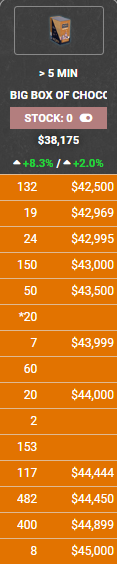
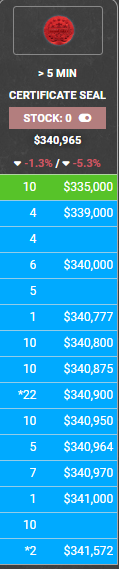
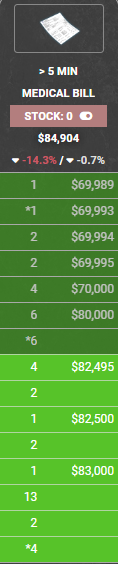
Identifying Markets: As mentioned above when going over necessary tools, Yata is a great way to easily identify how individual item markets are performing. Below are examples of three different types of markets.
- Performing Above Market Value: Example of a market performing above market value. With YATA, prices that are above or well above market price are represented by light and dark orange. A market performing above market value will typically look like this with maybe a few green or blue options at the top of the column. Markets like this typically make good flips, but you should still check to see if you will turn a high enough % profit for the flip to be worth while. You should also check to see if there is a large stack of items set as the cheapest or close to the cheapest items available. This can be an indication that market is being manipulated. See below how you can navigate a manipulated market.
- Performing At Market Value: Example of a market performing at market value. Prices that are just above or below the set market price for the day are represented by a blue bar. A market performing at expectations with little to no movement will look similar to this example with maybe a few green at the top and a few orange at the bottom. Markets like this are not immediately ready to be flipped unless something in the supply/demand changes in the game or if someone attempts to manipulate the market itself.
- Performing Below Market Value: Example of a market performing below market value. Prices that are below or far below the current market value are shown with a light green or flashing green bar. Seeing a full or mostly full column of green means the market is in decline or active free fall. Markets decline like this for a multitude of reasons. In some cases the prices had outstretched what people were willing to pay, pushing them to other items, active attempts to manipulate a market have ended, an event pushing demand has ended, or a balance change has been made changing the amount of item circulation. While you shouldn't try to flip actively falling markets the vast majority of the time, these types of markets can eventually create what I call a rebound market. This is where a price drop is too severe and the price drops below where standard demand would normally have it. This can create a situation when you can potentially buy up cheap stock just before or at the start of the price rebound if you play your cards right.
Trends to Spot: Now we get into the meat and potatoes of how to flip. Ya when it comes to flipping, you can make money buying incredibly underpriced items from noobs or people who fat thumbed the keyboard when setting up their bazaar, but that's not where the majority of the profits are at. Your profits are made by identifying market trends and taking risks with market speculation. A few things to look out for are…
-
Monitor for prices below market value: While you shouldn’t always do this, sometimes it's worth spending some of your precious API limit to track a few items that have an active market that might not have alot of profit between the market price and the current price. Some people sell below market price to get the item sold fast, other’s fail to check and post items at older/lower prices, either way you can turn a tidy profit. Some just make mistakes posting prices and miss a 0.
-
Market Manipulation: There is a lot of profit to be made in market manipulation, especially when you're only a participant instead of the mastermind. For example, go and look at Big Boxes of Chocolate. While this isn’t the case 100% of the time, there is a really good chance that outside of a handful of available chocolate on the market, most of it is being sold somewhere around 8%-12% above the current market price. Why? Because either an individual or a group have decided to buy up all the stock up to a point and sell it all at a high price. While this comes with considerable risk, it can be very profitable if other people catch on and start buying up stock with you. My advice, never be the person leading the manipulation, just ride their coattails and invest into it. The person leading the manipulation will always typically be super bought in and they’ll have to contend with being undercut quite often. On the other hand, you can buy a fraction of the stock as it becomes available, take on far less risk, and likely have most if not all your stock sold by the time the manipulator stops buying up stock.
-
Timed Markets: Different days create different markets depending on what's happening in the game. While many people buy ahead to be prepared for things like Wars and Events, some people wait till right before or during to buy what they need, creating a spike in demand. Cannabis before 420 and Blood Bags for Blood day are examples of items that increased in price before events, giving people some easy profits. Here’s a free piece of advice. I’d start preparing for International Beer Day.
-
Ched!: Game updates have direct impacts on prices (and not just negatively like with points). A good example is forgery items and wallets. Forgery created a new market of consumable items that were not easy to come across in the game without relying on completing older crimes. As people progressed through forgery, items like Bank Statements, Glow Sticks, Bonded Latex, and Med Bills sky rocketed in price. Then we suddenly got an announcement a few months later that wallet items would drop bank statements and med bills, killing their market prices but boosting the value of said wallet items. This also created a rebound market for the bank statements and med bills after their prices stabilized. Identifying these game changes early will help you identify where money can be made, while also letting you know what items you need to liquidate to lower your losses. While a big announcement for something like a new crime will typically be talked about in the paper, most of these changes are in the weekly update on the forum. Get used to reading it.
-
Know when to hold’em, know when to fold’em: Prices can’t go up with perpetuity and you don’t wanna be the one holding 1200 smoke grenades when a certain anticipated island war instead turns into a 6 month peace agreement (cough, cough). Prices do go down and it's always good to leave certain items alone for a while when you notice their markets slowing. Dropping prices do always settle, and when they do, more often than not they rebound, at least partially. When they do, that's the time to jump back in. Having said that, some items fall farther than others. Anyone buying HPCPU’s when they were 700K+ can tell you that. Sometimes, it's better to just liquidate what you have to try and avoid losing too much. There is never a guarantee a price will rebound to where it used to be, and selling out near or just below what you bought something for ends up just costing you wasted time instead of money. And even though you may take a loss, this freed up money can now be put back to better use flipping something else.
A few more pieces of advice that every flipper should know….
You don't have to track every item: As you get into flipping, you will start to learn prices for items that you may not actively track. It isn't a bad idea to get an idea of the general price of a multitude of items so you can spot deals as they appear in bazaars. You may pop into a bazaar to by a stack of Big Boxes of Chocolate and find they also have a good price on a few Boxes of Alcohol. Get and understanding of the prices of different items both big and small, and you'll be making plenty of secondary purchases that bring in a good profit all on their own.
Protect your money: This is Torn. You're going to get mugged. Muggers won’t always be people buying from you either. Limit how much money you keep on you when you are buying to protect yourself from sell muggers. If you ever make a lucrative sale, expect your profile to be pulled up on multiple muggers computers. Don’t make yourself an easy target. ALWAYS self hospitalize yourself with revives off, or fly. Whichever you decide to do, set timers so you are prepared to get out of the hospital or land. Personally, I prefer to fly 99% of the time. The 15 seconds of protection whenever you land is more than enough time to get your money into the stock market, and you can earn a bit extra from buying stock while overseas. 3/2: With Item Market 2.0, I've grown tired of constantly self medding and flying to protect myself. The solution there has been to ensure that I am not posting a sale for a single item for more than $10 million. This low sale price discourages mugging as the mugger won't earn enough money for it to be worth while, and its difficult for muggers to tell that you have much on the market if you are dealing in multiple items. If you are using a bazaar and posting several items you will still want to take advantage of self hosping or flying to avoid mugs.
Buy Muggers are your best customers: Don’t bother putting muggers on your enemies list. Every time you do, you lose a potential customer. One who is willing to spend extra at your bazaar with the hopes of getting some of their money back. Along with that, if you get mugged, just leave it alone. Don’t ask faction members to retaliate, don’t chat with them, just move on. There is no reason to risk attracting negative attention from someone who makes their living mugging sellers.
Take Days Off: Seems counter productive right? Every day you're not flipping, you're not making money. Fact is, working the markets, either as a flipper or a trader, is a very active way of earning money. Even on a light day, you might find yourself buying stock for 1-3 hours. Even if you're doing this in the background as you do something else, it can get boring from time to time. Add in a bad mug because of a missed timer, and it's easy to get burnt out and frustrated. It’s never a bad idea to take a day or two to just focus on flying. This can give you a chance to leave your bazaar open longer to sell off some harder to get rid of stock, while giving yourself a mental break. At the end of the day, it doesn’t matter how much money you're making if you're not having fun.
If you made it this far, congratulations. This took longer to write than I thought it would. Hopefully people find this information and my opinions helpful.
Update - Why I'm not recommending what items to flip: While I've mentioned a few items in this guide that you could flip (and they are items that I flip fairly regularly), I have decided to not go through an exhaustive list of the items that I regularly monitor and flip. There are two reasons why.
- There is not a single item in my own list that I monitor that I flip continuously. Some weeks they're money makers, some weeks I'm stuck sitting on a stack of items waiting for the price to rebound. I don't want someone reading a list I provide to think they are instant money makers, especially if they read this guide weeks/months/years later, to then get discouraged when they buy into something that they can't flip.
- I'm being very genuine when I say that the best why to start identifying trends and items to invest into is to experiment yourself. Review the prices on Yata, dip your toes into a few different items and see how fast they sell and at what markup. Watch the markets over the span of days to see when prices rise and when they fall. Getting used to doing this, opposed to simply flipping from a pre supplied list of items, is how you really grow your networth.
Update 2: Added a piece Trade Volume in the Items to Flip section. Added section called Identifying Markets where I cover using Yata to identify markets performing above, at, or below market value and discuss how to navigate those markets. Added piece discussing learning general item prices for items you don't actively track in the general advice section.